
Superfluous words are the enemy of good writing. I often come across writing that includes adjectives and adverbs that are either wrongly chosen to ‘qualify’ another word or are lazy choices (written without thinking whether they are necessary or appropriate). One of the best ways to avoid these inconsequential (lazy) qualifiers is to read back every sentence you write and pull out words that are used incorrectly or unnecessarily.
Always ask yourself: Is this adjective or adverb necessary? Is there a better descriptive word I could choose?
William Shrunk Jr. (1869—1946) was an English professor who wrote in his book ‘The Elements of Style’:
“‘Rather’, ‘very’, ‘little’, ‘pretty’— these are the leeches that infest the pond of prose, sucking the blood of words. The constant use of the adjective ‘little’ (except to indicate size) is particularly debilitating. We should all try to do a little better, we should all be very watchful of this rule, for it is a rather important one, and we are pretty sure to violate it now and then.” (Note: the italicised emphasis is my own)
If you’re writing dialogue then these ‘leeches’ are purely the natural way a character speaks. For example, I’m pretty sure that he had very little understanding of that rather shocking outburst.
But as Shrunk tells us: ‘Where emphasis is necessary, use words strong in themselves’. By adhering to this rule, the imagery, or even an argument, will be expressed with more colour and more meaning for the reader.
Let’s look at these four words.
1. Very
If you are reviewing your draft, be critical of every very you have used. For example,
He was very suspicious because he had never seen him smile.
As Simon Heffer writes in ‘Simply English’, he is convinced that writers today believe ‘… no point is considered adequately made unless it is beaten home with adjectives, adverbs and prolixity [using too many words]. The overuse of the word very … helps writers and speakers surrender a sense of proportion in handling all manner of subjects.’
Consider the same sample sentence above minus the word very. Is it debilitated because of its absence?
He was suspicious because he had never seen him smile.
A qualifier, like the adverb very, is a word that adds emphasis, supposedly enhancing or magnifying another word’s meaning. Overusing certain types of qualifiers such as very (or really) often reflects laziness by the writer as if not enough consideration has gone into the word choice.
Too often, very is used where it is unecssary (It was a very tragic death), or is inserted in a futile effort to prop up a weak word that would be better replaced by something with more punch.
The play was very good. Adding more punch without resorting to ‘very good’ could be: The play was superb.
2. Pretty
I chuckled when I read this sentence (with a name change) in an autobiography I recently assessed:
It seemed Maisie was pretty good in the fibs-and-lying department.
The author’s voice, and his unique way of expressing himself, came through strongly here. Although I was tempted to suggest an alternative to ‘pretty good’, I refrained. Reader, don’t judge me harshly! However, in general, the (insipid) adjective, pretty, should be used as intended — to describe an attractive person or object (and even then, I’m sure a better adjective could be chosen).
3. Little
As Shrunk (doesn’t need to) reminds us, the adjective little indicates size, so although you may introduce your ‘little sister’ to me, she may not be little but just younger. And although someone may be ‘feeling a little bit sick’, perhaps a better way of writing this is: ‘She was feeling nauseated’. Using both little and bit in the same sentence is redundant.
Shrunk would have a lot to grumble about in this sentence: ‘We had very little to do’.
4. Rather
The adverb, rather, is known as a determiner, often used to qualify, or give emphasis to, adjectives, such as:
He is rather unique.
She was rather smitten by him.
Something or someone is unique or not, as there are no degrees of uniqueness that I know of. The same goes for a word like ‘smitten’.
When writing prose, purists believe there are only two acceptable ways to use this innocuous word:
- If the adjective or adverb is susceptible to degree (rather cold, rather costly). But there’s always a better alternative such as ‘the coffee was lukewarm’ or ‘the tour cost a lot of money’.
- To indicate alternatives and preferences (orange rather than yellow, coffee rather than tea).
On the other hand, as mentioned above, when writing dialogue just about anything goes, such as ‘I rather like him’; ‘She’s rather deadly’.
As William Shrink Jr. declared, ‘Omit needless words’ … and I agree with him that ‘vigorous writing is concise’.
Are you seeking an editor?
 If you think it’s time to have an assessment of your writing project, or if you think it is ready for editing, I would be delighted to ‘hear’ from you.
I look forward to you sending me a message via my contact page or directly to denise@denisemtaylor.com.au with a brief overview of your project (you may be stuck!).
I will respond within 24 hours.
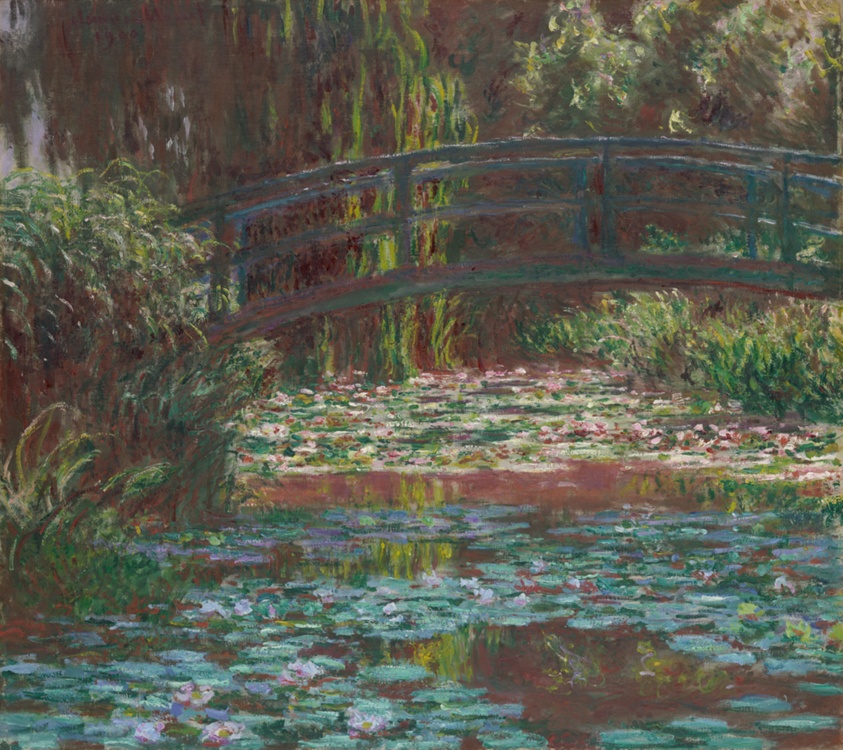
Featured image: Claude Monet, The bridge over the waterlily pond, 1900, oil on canvas, 89.8 x 101.0 cm, Art Institute Chicago, Illinois